

Category Archives: How Things Work

Crash and Smash Protection


Most security systems are programmed to have a brief delay before going off when you walk in the back door. This 30 second delay or more gives you time to disarm the system and prevent a false alarm.

What would happen if a burglar came into your home and heard the control box beeping? What if he knocked it off the wall or otherwise demolished it to prevent it from calling?

The Burns & McBride Smart, Safe Home system includes patented technology from its partner Alarm.com called “Crash and Smash” Protection

With Alarm.com’s exclusive technology, security system destruction can be detected during the entry delay, dialer delay or alarm dialing process, ensuring that even if an intruder is able to locate and disable a control panel in a “Crash & Smash” attack, Alarm.com will still be able to send a signal to the central station for help. Even better, Alarm.com’s advanced technology enables the use of important false alarm reduction features, without compromising security in the event of a real intrusion.

About Burns & McBride

Burns & McBride Home Comfort was founded in 1949 and is committed to providing dependable home comfort and safety services to homeowners throughout the Delaware alley. In addition to home security sales through its unique Smart, Safe Home system, it also provides homeowners with HVAC services, heating oil delivery and waste and recycling services. For more information on Burns & McBride please call us at 302-656-5110 or visit our website at www.burnsandmcbride.com

Leave a comment

Filed under Home Safety, Home Security, How Things Work, Uncategorized

Home Security 101 – What is “Z-Wave”?


Z-Wave: The New Standard in Wireless Remote Control

Z-Wave makes any home a “smart home” – quickly, easily and affordably! Z-Wave is a wireless system that lets all your home electronics “talk” to each other, and to you, via remote control. It uses simple, reliable, low-power radio waves that easily travel through walls, floors and cabinets – sort of like a baby monitor. Z-Wave control can be added to almost any electronic device in your house, even devices that you wouldn’t ordinarily think of as “intelligent,” such as appliances, window shades, thermostats and home lighting.


Z-Wave ties all your home electronics into one integrated wireless network, with no complicated programming and no new cables to run. Any Z-Wave enabled device can be  added to this network, and many non-Z-Wave devices can be made compatible by simply plugging them into a Z-Wave accessory module. In seconds, your device gets joined to the network and can communicate wirelessly with other Z-Wave modules and controllers.

And Z-Wave lets you control these devices in ways that give you complete command even when you’re not at home yourself. You can control your Z-Wave household remotely from a PC and the Internet from anywhere in the world…even through your cell phone!

• Z-Wave Is Simple – Z-Wave control is easily added to almost any device in minutes. Simply plug the device you want to control into a Z-Wave module, and “join” it to your Z-Wave network!

• Z-Wave Is Modular – With Z-Wave, you can add as much or as little home control as you want over time.  You can add Z-Wave to a device, a room, a floor or the entire home, according to your needs and desires.

• Z-Wave Is Affordable – Unlike costly whole-home control systems that need special wiring and professional installation, Z-Wave is accessible and easy for the do-it-yourselfer.

• Z-Wave Is Powerful – Z-Wave’s intelligent mesh networking ‘understands” the present status of any enabled device, and gives you confirmation that your devices have received the automatic or manual control commands you want.

• Z-Wave Is Versatile – Z-Wave can be added to almost anything in your home that uses electricity, and gives you the power to control or monitor them from your home or away from home.

• Z-Wave Is Intelligent – Z-Wave enabled devices can work together as a team.  Have your garage door turn on your house lights when you come home. Have your door locks notify you when your children arrive home from school. Turn your downstairs lights off from upstairs.  Create your own intelligent control “scenes” with Z-Wave!

The Burns & McBride Smart, Safe Home system uses Z-wave technology to tie things like locks, thermostats and lights together so that you can control them whether you are home or away. To learn more about Burns & McBride’s Smart, Safe Home can help you – callus at 302-656-5110 or visit our website at www.burnsandmcbride.com
Leave a comment

Filed under Home Security 101, How Things Work, Uncategorized

Try the Smart, Safe Home System For Yourself


As we’ve talked with homeowners, we’ve learned that there is no substitute for actually trying the Burns & McBride Smart, Safe Home system and finding out just what it can do.

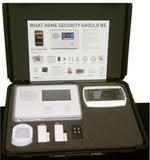
Our technicians have put together a demonstration kit that we can bring to you. It shows you how the system can protect your home, lock and unlock doors, adjust the thermostat and even turn lights on and off.

The best thing is that you can run the system yourself and get the feel of how easy it is to use

Great job guys in putting this together

Call us today at 302-656-5110 or visit our website at http://www.burnsandmcbride.com. We’ll be happy to schedule a time that’s convenient for you to actually try this system out.

Leave a comment

Filed under Energy Management, Home Security, How Things Work, Uncategorized

Home Security 101 – What is a Motion Detector?


There is definitely some mystery surrounding motion sensors. They are a core element of most alarm systems and a standard feature ion our Smart, Safe Home package. So, let’s dig into what they really do.

Motion sensors detect and report motion – in most cases when nobody is home (Armed-Away). That’s why they are not “awake” when you arm your system for the night (Armed-Stay) . It’s usually not practical to put a sensor on every window, and you usually don’t need to, since you can use motion sensors and glass break detectors to get the protection you need more affordably. Plus, motion sensors have come a long way from the original models – much more reliable, and less prone to false alarms.

How do they work?

The early motion sensors were considered “active” devices, because they emitted energy (microwave or ultrasonic) to see what was happening around them. There are some still some microwave sensors being installed in commercial spaces. Today the most common motion sensor uses Passive Infra-Red energy to detect heat given off by people (and animals!) – hence the name “PIR” given to the device. The smart detectors look for objects warmer than the normal background temperature, using a special lens to create “beams” of passive energy, and then look for motion: when the sensor detects a “warm” object moving across several beams within a specified time frame – that trips the alarm.

Where do you use them?

The standard range is 30-35 feet, and the coverage area is shaped like a large water droplet, with the skinny part at the detector. The ideal spot for a motion sensor is in a high-traffic area that an intruder would cross if moving about in your home or business: think hallways, living rooms with big-screen TV, etc. The sensors work better when people move across the beams, as opposed to approaching the sensor directly. The beams project out and down, to pick up anyone trying to avoid detection by crawling.

Motion sensors and pets

Today’s sensors are usually “pet-friendly” up to 40 pounds, which means they “ignore” cats and small dogs – unless your Siamese is downright acrobatic! That means that large dogs with the run of the house all day and night make it harder to use motion sensors – unless you kennel them!

 Things to Remember

Manufacturers recommend careful placement of their products to prevent false (non-intruder caused) alarms. They suggest mounting the PIDs in such a way that the PIR cannot ‘see’ out of a window. Although the wavelength of infrared radiation to which the chips are sensitive does not penetrate glass very well, a strong infrared source such as from a vehicle headlight or sunlight reflecting from a vehicle window can overload the chip with enough infrared energy to fool the electronics and cause a false alarm. A person moving on the other side of the glass however would not be ‘seen’ by the PIR.

They also recommended that the PIR not be placed in such a position that an heating and air conditioning vent would blow hot or cold air onto the surface of the plastic which covers the housing’s window. Although air emits very small amounts of infrared energy, the air blowing on the plastic window cover could change the plastic’s temperature enough to, once again, fool the electronic

Specifications

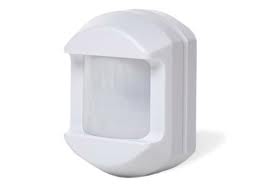
Based on the latest in infrared technology, the Burns & McBride motion detector comes with three different mounting brackets and a 90° lookdown, ensuring intruders cannot pass by unnoticed. It also communicates directly with tyour Burns & McBride Go!Control panel, so if the detector is triggered, the panel will connect you to the central monitoring station in as few as 17 seconds.

Dimensions and weight
  • Width: 2.5″
  • Height: 3.2″
  • Depth: 1.9″
  • Weight (including battery and brackets): 3.7 oz. (104.9 g)

Regulatory Listing(s)

  • ETL, FCC Part 15, Industry Canada
Features
  • 90° lookdown
  • 110° wide-angle spread
  • Three different mounting brackets
  • 30’x50′ range
  • 33–55 lb. pet immune
  • Five-year lithium battery
  • Tamper-protected
Benefits
  • 90° lookdown: Ensure that no one can walk beneath your sensor undetected
  • Tamper–proof: Know when someone is trying to tamper with your alarm
  • Fully monitored: Get connected to the Burns & McBride central monitoring station in as few as 17 seconds
Radio
  • Wireless signal range
  • 350 ft., open air, with 2GIG Wireless Alarm Control Panel
  • Transmitter Frequency
  • 345.000 MHz (crystal controlled)
  • Transmitter Frequency Tolerance
  • ± 15 kHz
  • Transmitter Bandwidth
  • 24 kHz
  • Modulation Type
  • Amplitude Shift Keying—On/Off Keying (ASK-OOK)
  • Peak Field Strength
  • Typical 50,000 uV/m at 3m
Housing
  • Material
  • ABS plastic and poly-carbonate
  • Color
  • White
  • Operating temperature
  • 32° to 120°F (0° to 49°C)
  • Relative Humidity
  • 5-95% Non-Condensing
  • Unique ID Codes
  • Over one (1) million different code combinations
  • Supervisory Interval
  • 70 minutes
Warranty
  • Lifetime
Included equipment and accessories
  • Battery (installed)
  • Two (2) Panasonic CR2032, or equivalent Lithium batteries
  • Included Accessories
  • Mounting brackets, two (2) long Phillip’s head screws, two (2) plastic wall anchors, magnet

For more information on this exciting product call us at 302-656-5110 or visit our website at http://www.burnsandmcbride. Finally you might want to follow our blog at http://www.burnsandmcbrideblog.com. Just as Smartphones are adding applications and changing every day so to with the technology behind our Smart, Safe home system. Our blog explains some of the constantly changing things that are happening in the industry and we hope that you find it informative.

Leave a comment

Filed under Home Safety, Home Security, Home Security 101, How Things Work, Uncategorized